
“My experience is what I agree to attend to.” William James, The Principles of Psychology (1890)
Why Strategic Listening Matters in Leadership
William James wrote extensively about the psychology of attention: the way our minds select certain parts of experience and allow them to shape our understanding. For leaders, that selection happens constantly as our experience helps us recognize patterns, anticipate problems and make decisions. It also influences which details catch our attention, which explanations feel plausible and which questions arise in our interactions.
When we walk into a meeting with years of experience behind us we sometimes form an early impression of the room. We may recognize the familiar disagreement, sense where the discussion is heading and draw conclusions, or have a view on the proposal, the people around the table, and the decision that needs to be made, sometimes very quickly.
Our perceptions are sometimes accurate and, in my experience as an executive coach, often incomplete.
A colleague’s objection might reveal a risk that has been overlooked or a familiar agreement might conceal an assumption nobody has tested. Silence might reflect the weight of the leaders position in the room while a complicated discussion might be exposing an underlying question that holds promise and deserves exploration.
The central discipline of strategic listening asks: As the leader in the room, are we willing to have our understanding changed by what we hear?
Because it is November, and thankfulness is a common theme, it is important to reference it in relationship to listening. Gratitude, in this context, begins with recognition that another person’s experience, judgment, attention or question has value before we have decided what to do with it. When we listen with gratitude, we give another person’s experience enough weight to influence our own understanding.
For Senior Leaders, this has practical consequences. The quality of a decision depends partly on the information available to the people making it. However, the information available depends, in part, on what the room makes possible to say, question, and explore.
To read a room well, we have to recognize the conditions shaping its conversation. Four patterns are especially useful to notice.
Four Room Patterns That Shape Leadership Decisions
1. Misplaced Conflict: When the Argument Obscures the Shared Objective
Two colleagues are debating a proposed course of action. Each makes a convincing case. The discussion grows more detailed, the positions grow firmer, and the original objective recedes from view.
Listen beneath the positions for the assumption creating the disagreement.
One person may believe speed is essential; the other may be protecting reliability. Both may want the same outcome while holding different views about what achieving it requires.
A strategic listener brings the underlying issue into focus with a question:
“What is the real issue this conflict is masking?”
The question invites the people involved to examine the thinking beneath their positions. It may reveal a genuine difference in priorities, an assumption that needs testing, or a shared objective obscured by competing solutions.
When you understand what the disagreement is actually about, you can direct attention toward the issue that needs to be resolved.
2. Unexamined Consensus: Challenge Assumptions Before Agreeing
The proposal receives a warm reception and heads nod around the table. People begin discussing next steps, and the meeting appears to be moving efficiently toward a decision.
Pay attention to how quickly the agreement formed.
Someone may remember a failed attempt that has not come up or a team member may see a risk that feels difficult to introduce once the room has settled. The group may have accepted an assumption simply because it fits the prevailing view.
Listen beneath agreement for reservations, risk and experience held in reserve.
“What would make this harder than it looks?”
This question invites the room to examine its confidence. It gives experience a chance to enter the discussion so the decision can still benefit from it.
Agreement becomes more durable when the reasoning behind it has been examined. Strategic listening helps you discover what the group has considered, what remains uncertain and what might change the decision.
3. Authority Gravity: When Hierarchy Shapes the Conversation and Outcome
The most senior person offers an opinion and others respond, as supporting evidence begins building around that view.
Everyone may be thoughtful and well intentioned but the bottom line is hierarchy still influences the conversation as people consider how their words will land. They decide how directly to challenge a proposal and they weigh the value of raising a concern against the effort of introducing it. Meanwhile, the person with the greatest authority may have the least direct contact with the detail under discussion.
Make room for the people closest to the customer and implementation by asking:
“Before we decide, I want to hear more from those closest to the work.”
Their proximity gives them access to information the room needs and it is important to create space before it is too late.
Strategic listening requires you to account for your own influence on the conversation. Your position affects what others are prepared to say, and your questions can help determine whether their experience has a chance to weigh in on the decision.
4. Premature Resolution: When the Room Resolves Discomfort Before the Opposition Has Matured
A conversation becomes complicated for many reasons. Maybe a new question unsettles the original proposal or people introduce competing explanations, qualify their positions and begin exploring possibilities that are creating palpable friction in the room.
As the room may become harder to manage, experienced leaders often respond by bringing the discussion back into focus. You may synthesize the views, identify the common ground and move the group toward a decision. These are valuable capabilities but…
A promising direction may need to survive a little uncertainty before its value becomes clear and it is important to stay with the complexity long enough to discover what it reveals.
“What has become clearer because this got more complicated?”
The question invites the group to examine what the discussion has produced. It gives emerging ideas room to develop and helps distinguish productive uncertainty from a conversation that has lost its purpose.
A conversation can become harder to manage at precisely the moment it becomes more interesting.
The Strategic Listening Framework: What to Notice in Meetings
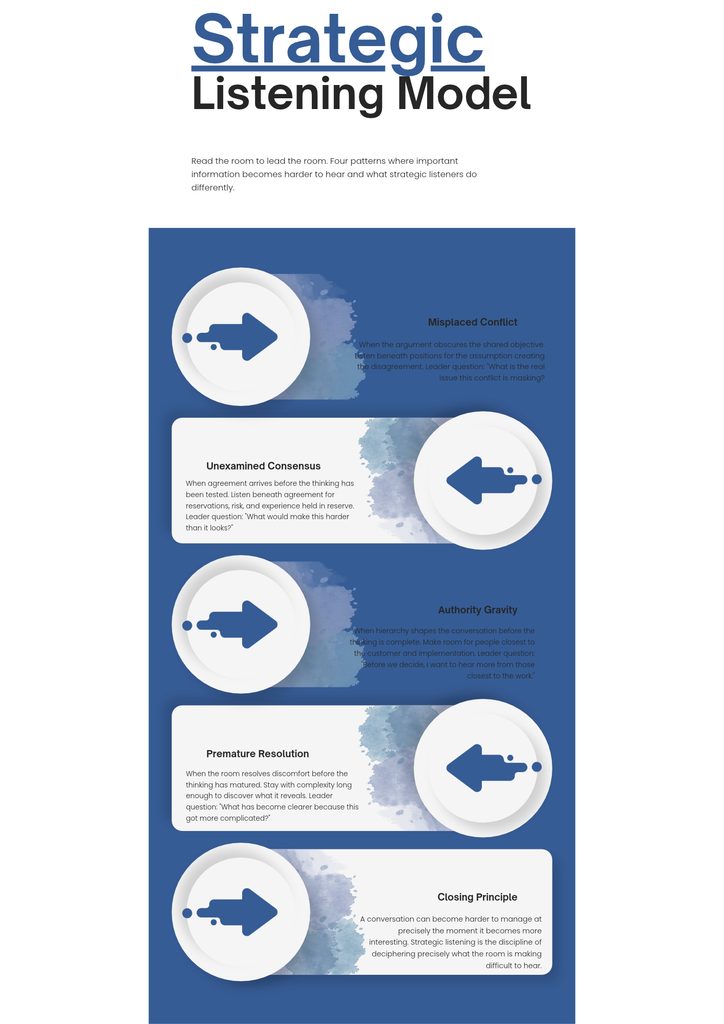
Before you enter your next meeting, consider what you currently believe about the issue and what evidence might change your view. During the discussion, notice who speaks first, how quickly agreement forms, whose expertise receives attention and what happens when the conversation becomes uncomfortable.
When you recognize a pattern, use the corresponding question. Give the response room to develop and take shape. Listen for what you had not considered, what challenges your assumptions and what makes your understanding of the issue have more depth and breadth.
How Strategic Listening Builds Trust and Improves Decisions
Gratitude begins with recognizing value in another person’s contribution, including its potential to change our perspective. Our willingness to attend to that contribution influences what we can learn from it.
This is one of the rewards of strategic listening. We become more aware of the knowledge around us, more precise in our judgments and more capable of making decisions informed by perspectives beyond our own. The people in the room gain a leader who they trust will invite their contributions while we gain access to a fuller understanding of each issue worth exploring. That is the heart of the discipline of strategic listening.
To revisit the opening quote, our experience is what we agree to attend to, and it begins by listening with the will to learn.
Leave a Reply